English
Expectations from EYFS
This involves encouraging children to read and write, both through listening to others reading, and being encouraged to begin to read and write themselves.
ELG 10 Writing: children use their phonic knowledge to write words in ways which match their spoken sounds. They also write some irregular common words. They write simple sentences which can be read by themselves and others. Some words are spelt correctly and others are phonetically plausible.
Expectations from the National Curriculum
KS1
Year 1
The National Curriculum English programmes of study for Key Stage (KS) 1 and KS2 set out what genres and topics pupils must cover.
Pupils should be taught to "develop pleasure in reading, motivation to read, vocabulary and understanding" (page 11) by:
-
Listening to and discussing a wide range of poems, stories and non-fiction at a level beyond that at which they can read independently
-
Becoming very familiar with key stories, fairy stories and traditional tales, retelling them and considering their particular characteristics
-
Learning to appreciate rhymes and poems, and to recite some by heart
The writing composition requirements (page 14) say that year 1 pupils will be expected to start forming short narratives.
Year 2
For reading comprehension, pupils should:
-
Listen to, discuss and express views on ‘contemporary and classic poetry, stories and non-fiction’
-
Become increasingly familiar with and retelling a wider range of stories, including fairy stories and traditional tales
-
Be introduced to non-fiction books that are structured in different ways
This is set out on page 18 of the programmes of study.
Pupils should be writing:
-
Both fictional and real narratives about their own experiences and those of others
-
Poetry
-
About real events
-
For different purposes
The requirements for writing composition are on page 21 of the programmes of study document.
KS2
Years 3 and 4
Pupils should listen to and discuss a wide range of:
-
Fiction
-
Poetry
-
Plays
-
Non-fiction
-
Reference books or textbooks
Pupils should also read books that are structured in different ways, and they should read for different purposes. They should also increase their familiarity with a wide range of books, including fairy stories, myths and legends.
This is set out on pages 25-26 of the programmes of study, linked to above.
The writing composition requirements are set out on page 29.
At this level, pupils are expected to create narratives, including settings, characters and plot, and compose non-narrative material.
Years 5 and 6
Pupils should be taught to maintain positive attitudes to reading and understand what they read by:
-
Continuing to read a wide range of fiction, poetry, plays, non-fiction and reference books or textbooks
-
Reading books that are structured in different ways and reading for a range of purposes
-
Increasing their familiarity with a wide range of genres, including:
-
Myths and legends
-
Traditional tales
-
Creation Stories
-
Stories from other cultures
-
Modern fiction
-
Fiction from British literary heritage
-
This is covered on pages 33-34 of the programmes of study.
The writing composition requirements for years 5 and 6, listed on pages 37-38, include writing narrative that describes:
... settings, characters and atmosphere, and [integrate] dialogue to convey character and advance the action.
INTENT
Writing Mastery
Mastery learning is the principle that all children can and will learn when given the right conditions, time, and teaching. Rather than moving on when some children are still insecure, mastery ensures pupils grasp key concepts deeply before progressing. Cognitive science supports this by showing that secure understanding, built through practice and retrieval, strengthens long-term memory and transfer. By removing the "gap-widening" effect of traditional pacing, mastery enables equity and excellence for every learner. It is therefore considered one of the most impactful approaches to ensuring sustained progress for all.
In writing, mastery means pupils secure the core components of composition, transcription, and vocabulary, grammar, and punctuation (VGP) before moving on to more advanced skills. Teaching builds in purposeful practice and consolidation, ensuring all pupils can apply these skills fluently, flexibly, and independently. Progression is therefore viewed as a deepening of control and refinement, not a race through content.
At Freeland, our intention is to:
-
Enable the children to communicate in writing clearly, confidently and appropriately, demonstrating an awareness of a variety of purposes and audiences.
-
Create a genuine love of writing and an appreciation of its value, so that children choose to write and are able to organise and structure a variety of texts, whilst developing their imagination and critical awareness. This will help to assist the children in becoming independent writers.
-
Provide opportunities for writing across all areas of the curriculum to make it relevant and meaningful and allow opportunities for application of skills.
-
Ensure that teaching and learning of writing is consistent across school, to aid children’s progress.
-
Encourage children to present their writing to a high standard, at each of the stages of the writing process: planning, drafting, editing and re-drafting.
We encourage the children to:
-
express opinions, articulate feelings and formulate responses to a range of texts both fiction and non-fiction using appropriate technical vocabulary;
-
foster an interest in words and their meanings, and to develop a growing vocabulary in both spoken and written form;
-
enjoy and engage with and understand a range of text types and genres;
-
be able to write in a variety of styles and forms showing awareness of audience and purpose;
-
develop powers of imagination, inventiveness and critical awareness in all areas of literacy;
-
use grammar and punctuation accurately;
-
understand spelling conventions;
-
produce effective, well-presented written work.
IMPLEMENTATION
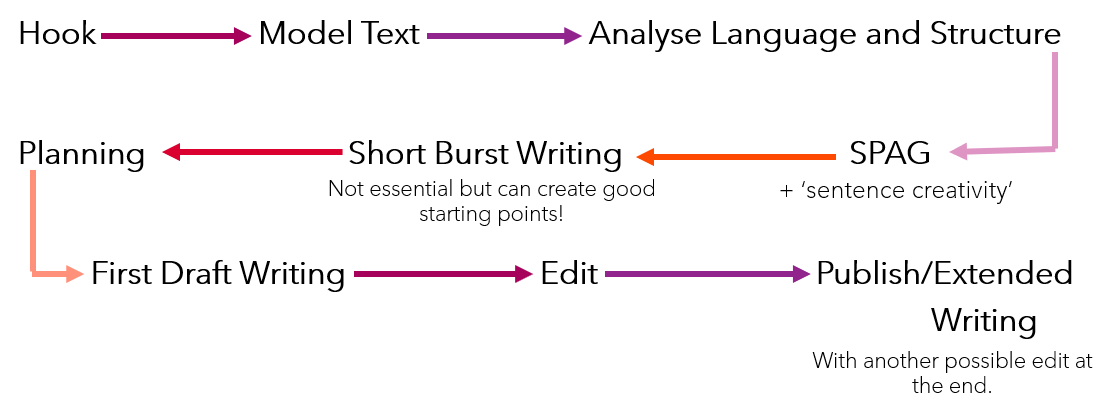
Hook
All writing tasks begin with the initiate stage, where children are given a ‘Hook’ to engage them with the text type. This may include: drama, a visitor, trip or other engaging activity. This is the introductory stage of the writing process – inspiring the children to want to write in the given genre.
Model text
Modelling starts with the Model Text. Language features are presented – providing accurate and correctly-used examples of the features that appear in the given genre. The language features can be based upon SPAG, Organisational, Tone and Language choice. Texts are differentiated for varying abilities and year groups within mixed cohorts (where appropriate).
Although we use the Model Text to model and identify language features – it is the expectation that teachers continue to model throughout the writing process.
Analyse Language and Structure
Direct teaching is used at this stage in the writing process. Children use the text to explore and consolidate understanding of the language features as per NC objectives.
Teachers can direct their learning focus onto a range of writing areas that are specific to genre – for example: A year one instruction text would require specific learning input on imperative verbs. Or a year 5 narrative fiction module may need specific input on identifying and using various elements of meta language.
SPAG
Within the Model Text there are examples of effective SPAG – providing a range of age/level-appropriate sentence and punctuation. When analysing the language features of the genre, the exploration and modelling of SPAG is continued throughout.
Prior learning and lesson starters are utilised as opportunities to revise and test the children on both accurate punctuation, technical vocabulary/concepts and grammar – all linked to the studied genre, source material: making it relevant to the children’s writing.
Short Burst Writing
Within this process, the Model Text is changed. Here, the teacher demonstrates how to change the content/subject of the piece of writing, whilst retaining examples of the language features. Children can work either in groups or independently to edit and improve the text – exploring how to retain the planned structure/organisation of the source material, whilst collaboratively creating something new. This is can be used as a non-essential part of the writing process, one that gives the children the skills to embark on the next stage.
Planning for Writing
Planning is an essential element of the writing process. When examining the structure of a Model Text, the conventions of the genre are explored.
For example: In a non-chronological report, the teacher will identify how information is presented in a variety of structural methods, such as: bullet points, fact boxes, paragraphs (with sub-headings), diagrams/images with captions and an introduction and conclusion.
When planning narrative fiction, the teacher can identify the genre troupes of an adventure story by organising the text into a text map or story mountain, with an opening, build up, problem, resolution and ending.
It is important, however, that as children progress through the school, they are provided with a wider range of narrative structures that offer opportunity to independently vary how they construct their plots.
For example: If a year 5 pupil is planning a myth or legend, they may include a section of planning that focuses on a journey or voyage or the addition of a second problem. Similarly, the narrative construction can be manipulated to end a story with a cliff-hangar or opening a story with a flash forward or flashback.
Pupils utilising these structural manipulations demonstrate an awareness of the reader as well as insight into the genre.
Children can set out to plan their own text using a scaffold from the source text. To provide opportunities for more able children, they can create their own plan.
When planning, the children consider how they will use the appropriate language features for the genre, including: SPaG, Organisational elements, Tone and Language choices. These will be specified in a differentiated Success Criteria.
First draft
When writing their first draft, children follow their plan to create the initial draft of their writing – including as many of the appropriate or focus language features of the genre.
Edit and improve
Editing is a discreet skill in writing that can greatly impact a child’s attainment throughout their education. From KS1 and beyond, children are taught the specific skills of editing and improving through focused sessions and modelling. When planning a unit of writing, teachers must include at least one session where the children can have time to respond to feedback from a teacher or peer – or to reflect on their previous drafting.
Additional opportunities to model and develop editing skills are found through dictation, prior learning reviews and other such SPAG-related starters.
Green pens are used across the school for editing and improving writing.
When editing, the children have opportunities for peer assessment – reading aloud to promote their understanding of sentence fluency, and opportunities for further embellishment of sentences.
Children can recognise and use the school marking code – as found in the front of all books.
Publish
The publishing element of the process is essential to the school’s philosophy on writing.
Children are encouraged to present their work in a relevant manner – in relation to the genre. For example: a letter is posted; a play or story is performed; instructions are carried out.
Children are given the opportunity to create a final ‘best’ version of their writing – that can be stored in the class reading area and is available to be shared with other readers.
Checkpoint writes
Guidance for Independent Writing Tasks
During each short term, children will complete at least one—and ideally two—independent writing tasks in a genre they have previously been taught, but not immediately before the task. This task should:
-
Be completed within one lesson (appropriately 30 minutes for KS1 and 45 minutes for KS2).
-
Be completed with as much independence as is realistic for the child—scaffolds from prior lessons (e.g., word mats, vocabulary, displays) may remain visible, but teachers should not guide or model during the writing unless support is needed (e.g. SEND).
-
Reflect each child’s current writing ability without adult intervention, unless support is needed for engagement (e.g. SEND), which should be taken into account when making judgements.
-
Include time to edit using a different coloured writing tool for composition, vocabulary, grammar and punctuation (VGP), and transcription. This can be carried out with a partner, allowing pupils to improve both their own and others’ writing by giving and receiving feedback.
Purpose of a Checkpoint Write.
It provides a clear snapshot of what children can achieve independently at this stage of their writing journey.
It must be used to highlight misconceptions, identify exemplars and inform the upcoming planning: notice, respond and adapt!
Checkpoint Writes help teachers track progress across the year toward writing independence and refinement by Assessment Point 3 (AP3).
Resources for writing – texts, hooks and support
-
Literacy shed – for texts and audio-visual aids
-
A range of fiction and non-fiction texts - both in class and in the library
-
Long term/Medium term overviews of genres and texts to aid teachers in structuring writing projects and forging cross curricular links
-
Access to school trips and visitors to Initiate interest and engagement in the given Source text
-
RWinc
-
PiXL SPAG assessment
-
Thesaurus’
-
Pobble365
-
Dictionaries
-
Planning frames
Inclusion and Inclusion Resources
All children receive quality first literacy teaching on a daily basis and activities are differentiated accordingly. In addition, where identified pupils are considered to require targeted support to enable them to work towards age appropriate objectives, intervention programmes will be implemented e.g. Letters and Sounds (1), Launch into Reading Success, Read Write Inc, Project x Code, New Reading and Thinking, Trugs – 5 min boxes, Toe by Toe, Class comprehension boxes, Language for thinking, Teachers and teaching assistants plan programmes together and monitor progress of these pupils.
IMPACT
Assessment, Monitoring, Recording and Reporting
STRATEGIES FOR RECORDING AND REPORTING
At the end of every unit, children will complete a piece of writing linked to the text type they have been studying. This will allow the teacher to assess children’s progress, current level of writing skill and then identify next steps for the child in some of the ways outlined above e.g. target setting, oral/ written feedback etc. Focus level descriptors will be used from Year 1 through to Year 6 to ensure consistency. The school tracking system for writing is updated for every pupil on a termly basis. (See Assessment policy for more detail).
EYFS record and report through observations, photographs, things children have written, made or drawn, and information from parents. Recording and reporting comes from child-initiated activities, as well as from adult initiated activities. These assessments are stored within evidence files or Early Learning Journals and can also be recorded as evidence on Tapestry.
The summative assessments, in EYFS, are used to complete the EYFS profile.
Assessments are made in line with the school assessment policy.
Teachers use effective assessment for learning to ensure planning is based on prior attainment and that pupils know what they need to do to achieve the next steps. Group or individual targets are set accordingly.
Marking is in line with the school marking and feedback policy – offering next steps to make sure that children are aware of their own targets for learning and supported to make progress towards them. Children are also involved in setting their own next steps to success and encouraged to review their progress towards these through self, peer and teacher assessment.
Moderation is carried out once a term – whereby all class teachers moderate writing from across the school. The children are selected based randomly or based on a school-wide focus e.g. Pupil Premium or SEN. In addition to in-school moderation, Freeland takes part in moderation within the EPA.
Children are monitored in SPAG and assessed against the PiXL/Arbor – linked to National Curriculum Targets.
Monitoring, tracking and assessment: Mastery journey across the year
The progression of statements from AP1 to AP3 reflects a developmental pathway towards independence and refinement.
Composition:
secure structure and clarity (AP1)
experiment with range and cohesion (AP2)
write fluently and editing deliberately for effect (AP3)
VGP:
secure foundational grammar and vocabulary (AP1)
build control and complexity (AP2)
demonstrate confident, accurate, and flexible application (AP3).
Transcription:
accuracy and legibility (AP1)
secure and consistent control (AP2)
achieve fluency and precision, presenting their writing clearly and with attention to detail (AP3)
What does the writing assessment process look like?
Assessment Evidence will come from both:
-
Published writing pieces at the end of a writing journey.
-
More reliably, tepid writes (semi-independent tasks) that are planned into the summative assessment window (e.g. between AP1 and AP2).
-
At each assessment point (AP1, AP2, AP3), there are approximately:
-
6 Composition statements
-
6 Vocabulary, Grammar & Punctuation (VGP) statements
-
2–3 Transcription statements
These must be secure to judge a pupil as working at the Age-Related Expectation (ARE).
-
-
A pupil may still be judged as ARE if they are secure in all but one specific area, such as:
-
Handwriting
-
Spelling
-
Standard English
-
-
If a pupil is clearly secure in all ARE criteria, teachers may refer to the layered Greater Depth (GD) criteria for that assessment point, which also includes composition, VGP, and transcription elements.
-
Teachers will record judgements for each child on the assessment spreadsheet, marking each statement as green (secure) or red (not yet secure).
-
This acts as a diagnostic tool to identify gaps.
-
The spreadsheet auto-calculates cohort-level data, supporting planning for whole-class, small-group, and individual intervention.
-
-
The frameworks do not assess every single taught objective: just as in maths and reading, some objectives are harder to assess via formal outcomes.
-
Unassessed but essential skills (e.g. planning, idea generation) must still be taught and embedded, even if not directly reflected in assessment criteria.
Writing Statement Progression
The progression of the statements from AP1 to AP3 reflects a developmental journey towards independence and refinement in writing.
For Composition, pupils move from securing core skills such as structure, clarity, and basic paragraphing at AP1, to developing range and control at AP2; this includes experimenting with form, enhancing description, and achieving cohesion across paragraphs. By AP3, children are expected to demonstrate independent application, shaping their writing with fluency and editing deliberately for effect.
For Vocabulary, Grammar and Punctuation (VGP), pupils begin by securing the foundations of sentence construction and vocabulary use at AP1. At AP2, they develop greater control and variety, using increasingly complex grammatical structures. By AP3, they should demonstrate confident, accurate, and flexible application of grammar and punctuation to enhance meaning and impact.
For Transcription, AP1 focuses on accuracy in basic spelling and letter formation, establishing fluent transcription habits. AP2 sees the development of greater consistency and control, including the secure spelling of more complex words and joined, legible handwriting. At AP3, pupils are expected to write with automaticity, fluency, and accuracy, presenting their work clearly and consistently with attention to detail.
The writing statement areas
What is meant by Composition’?
Composition is the process of crafting writing that is purposeful, well-structured, and engaging for the reader. It involves writing with a clear awareness of audience and purpose, using structure, vocabulary, and detail to create a specific effect on the reader, whether to inform, persuade, entertain, or evoke emotion. Strong composition also includes planning and organising ideas, developing content (such as character, setting, and plot in narrative), and using paragraphing and cohesion to guide the reader through the text. It requires reviewing and improving writing to ensure clarity and impact. Crucially, children should draw on models and techniques from their reading, using what they have seen in high-quality texts to shape their own writing choices.
What is meant by Vocabulary, Grammar and Punctuation (VGP)?
Vocabulary, Grammar and Punctuation (VGP) refers to the technical accuracy and precision with which pupils construct their sentences, and the choices they make to enhance meaning and effect. It includes tense control and subject–verb agreement, ensuring writing is coherent and grammatically accurate. It covers the use of punctuation to separate clauses and sentences, including accurate speech punctuation, and the deployment of subordinate clauses to add detail and complexity. Pupils should use a range of adverbials for time, place, and cause, as well as other grammatical devices, to vary sentence openings and link ideas.
In terms of vocabulary, pupils are expected to make deliberate, purposeful word choices—selecting words for precision, impact, or tone. This includes lifting or adapting vocabulary and phrasing from texts they’ve read, such as adjectives, verbs, or repeated refrains, to enhance their own writing. The emphasis is not only on correctness but on using grammar and vocabulary to make writing more powerful, fluent, and fit for its intended audience and purpose.
What is meant by Transcription?
Transcription refers to the accuracy and fluency with which pupils encode their ideas into written form, focusing on spelling, handwriting, and general presentation. It includes secure knowledge and application of spelling rules and patterns, including age-appropriate common exception words and morphological knowledge (such as prefixes and suffixes). Pupils are expected to spell words correctly and consistently across their writing.
In handwriting, transcription involves forming letters correctly, joining fluently (where appropriate for the year group), and maintaining a consistent and legible style. Presentation should reflect the pupil’s pride in their work and be appropriate for the audience and purpose. While some transcription elements (such as handwriting and spelling) can form barriers to an ARE judgement, a child may still be judged as working at the expected standard if one of these are the only insecure elements and all compositional and grammatical aspects are secure.
Spelling
Common Exception Words
- Year 5 and 6 Common Exception words
- Year 3 and 4 Common Exception words
- Year 2 Common Exception words
- Year 1 Common Exception words
Statutory Spelling Lists
- Year 3 and 4 Statutory Spellings
- New Curriculum Spellings Year 1 and 2
- Year 5 and 6 Statutory Spellings
- High Frequency Words Year 1 and 2
Phonics Provision - Little Wandle
Intent
Phonics (reading and spelling)
At Freeland we believe that all our children can become fluent readers and writers. This is why we teach reading through Little Wandle Letters and Sounds Revised, which is a systematic and synthetic phonics programme. We start teaching phonics in Reception and follow the Little Wandle Letters and Sounds Revised progression, which ensures children build on their growing knowledge of the alphabetic code, mastering phonics to read and spell as they move through school.
As a result, all our children are able to tackle any unfamiliar words as they read. At Freeland, we also model the application of the alphabetic code through phonics in shared reading and writing, both inside and outside of the phonics lesson and across the curriculum. We have a strong focus on language development for our children because we know that speaking and listening are crucial skills for reading and writing in all subjects.
Comprehension
At Freeland, we value reading as a crucial life skill. By the time children leave us, they read confidently for meaning and regularly enjoy reading for pleasure. Our readers are equipped with the tools to tackle unfamiliar vocabulary. We encourage our children to see themselves as readers for both pleasure and purpose.
Because we believe teaching every child to read is so important, we have a Reading Leader who drives the early reading programme in our school. This person is highly skilled at teaching phonics and reading, and they monitor and support our reading team, so everyone teaches with fidelity to the Little Wandle Letters and Sounds Revised programme.
Foundations for phonics in Reception
-
We provide a balance of child-led and adult-led experiences for all children that meet the curriculum expectations for ‘Communication and language’ and ‘Literacy’. These include:
-
sharing high-quality stories and poems
-
learning a range of nursery rhymes and action rhymes
-
activities that develop focused listening and attention, including oral blending
-
attention to high-quality language.
-
-
We ensure Reception children are well prepared to begin learning grapheme-phoneme correspondences (GPCs) and blending.
Daily phonics lessons in Reception and Year 1
-
We teach phonics for 30 minutes a day. In Reception, we build from 10-minute lessons, with additional daily oral blending games, to the full-length lesson as quickly as possible. Each Friday, we review the week’s teaching to help children become fluent readers.
-
Children make a strong start in Reception: teaching begins in Week 2 of the Autumn term.
-
We follow the Little Wandle Letters and Sounds Revised expectations of progress:
-
Children in Reception are taught to read and spell words using Phase 2 and 3 GPCs, and words with adjacent consonants (Phase 4) with fluency and accuracy.
-
Children in Year 1 review Phase 3 and 4 and are taught to read and spell words using Phase 5 GPCs with fluency and accuracy.
-
Daily Keep-up lessons ensure every child learns to read
-
Any child who needs additional practice has daily Keep-up support, taught by a fully trained adult. Keep-up lessons match the structure of class teaching, and use the same procedures, resources and mantras, but in smaller steps with more repetition, so that every child secures their learning.
-
We timetable daily phonics lessons for any child in Year 2 or 3 who is not fully fluent at reading or has not passed the Phonics screening check. These children urgently need to catch up, so the gap between themselves and their peers does not widen. We use the Little Wandle Letters and Sounds Revised assessments to identify the gaps in their phonic knowledge and teach to these using the Keep-up resources – at pace.
-
If any child in Year 3 to 6 has gaps in their phonic knowledge when reading or writing, we plan phonics ‘catch-up’ lessons to address specific reading/writing gaps. These short, sharp lessons last 10 minutes and take place at least three times a week.
Teaching reading: Reading practice sessions three times a week
-
We teach children to read through reading practice sessions three times a week. These:
-
are taught by a fully trained adult to small groups of approximately six children
-
use books matched to the children’s secure phonic knowledge using the Little Wandle Letters and Sounds Revised assessments and book matching grids on pages 11–20 of ‘Application of phonics to reading’
-
are monitored by the class teacher, who rotates and works with each group on a regular basis.
-
-
Each reading practice session has a clear focus, so that the demands of the session do not overload the children’s working memory. The reading practice sessions have been designed to focus on three key reading skills:
-
decoding
-
prosody: teaching children to read with understanding and expression
-
comprehension: teaching children to understand the text.
-
-
In Reception these sessions start in Week 4. Children who are not yet decoding have daily additional blending practice in small groups, so that they quickly learn to blend and can begin to read books.
-
In Year 2 and 3, we continue to teach reading in this way for any children who still need to practise reading with decodable books.
Home reading
-
A decodable reading practice book is taken home to ensure success is shared with the family.
-
‘Reading for pleasure’ books also go home for parents to share and read to children.
-
We use the Little Wandle Letters and Sounds Revised parents’ resources to engage our families and share information about phonics, the benefits of sharing books, how children learn to blend and other aspects of our provision, both online and through workshops.
Additional reading support for vulnerable children
-
Children in Reception and Year 1 who are receiving additional phonics Keep-up sessions read their reading practice book to an adult daily.
Ensuring consistency and pace of progress
-
Every teacher in our school has been trained to teach reading, so we have the same expectations of progress. We all use the same language, routines and resources to teach children to read so that we lower children’s cognitive load.
-
Weekly content grids map each element of new learning to each day, week and term for the duration of the programme.
-
Lesson templates, Prompt cards and How to videos ensure teachers all have a consistent approach and structure for each lesson.
-
The Reading Leader and SLT use the Audit and Prompt cards to regularly monitor and observe teaching; they use the summative data to identify children who need additional support and gaps in learning.
Ensuring reading for pleasure
‘Reading for pleasure is the single most important indicator of a child’s success.’ (OECD 2002)
‘The will influences the skill and vice versa.’ (OECD 2010)
We value reading for pleasure highly and work hard as a school to grow our Reading for Pleasure pedagogy.
-
We read to children every day. We choose these books carefully as we want children to experience a wide range of books, including books that reflect the children at Freeland and our local community as well as books that open windows into other worlds and cultures.
-
Our English curriculum provides high quality texts, related to topics which are used as a stimulus for writing genres.
-
Shared reading is planned once a week with different classes
-
Guided Reading sessions are taught daily using high quality, age-appropriate texts. The children answer VIPERS style questions to enhance reading comprehension, memory, and vocabulary
-
Every classroom has an inviting book corner that encourages a love for reading. We curate these books and talk about them to entice children to read a wide range of books.
-
In Reception, children have access to the reading corner every day in their free flow time and the books are continually refreshed.
-
Children in Reception to Year 4/5 onwards have a home reading record. The parent/carer records comments to share with the adults in school and the adults will write in this on a regular basis to ensure communication between home and school.
-
In Year 6 the children have time once a week to write their own comments and keep a list of the books/authors that they have read over the week.
Impact
Assessment
Assessment is used to monitor progress and to identify any child needing additional support as soon as they need it.
-
Assessment for learning is used:
-
daily within class to identify children needing Keep-up support
-
weekly in the Review lesson to assess gaps, address these immediately and secure fluency of GPCs, words and spellings.
-
-
Summative assessment is used:
-
every six weeks to assess progress, to identify gaps in learning that need to be addressed, to identify any children needing additional support and to plan the Keep-up support that they need.
-
by SLT and scrutinised through the Little Wandle Letters and Sounds Revised assessment tracker, to narrow attainment gaps between different groups of children and so that any additional support for teachers can be put into place.
-
-
The Little Wandle Letters and Sounds Revised placement assessment is used:
-
with any child new to the school to quickly identify any gaps in their phonic knowledge and plan provide appropriate extra teaching.
-
Statutory assessment
-
Children in Year 1 sit the Phonics screening check. Any child not passing the check re-sits it in Year 2.
Ongoing assessment for catch-up
-
Children in Year 2 to 6 are assessed through:
-
their teacher’s ongoing formative assessment
-
the Little Wandle Letters and Sounds placement assessment
-
the appropriate half-termly assessments.
For support on phonics and reading- please follow the page below.
Phase 2 sounds taught in Reception Autumn 1
Phase 2 sounds taught in Reception Autumn 2
Phase 3 sounds taught in Reception Spring 1
How we teach blending